
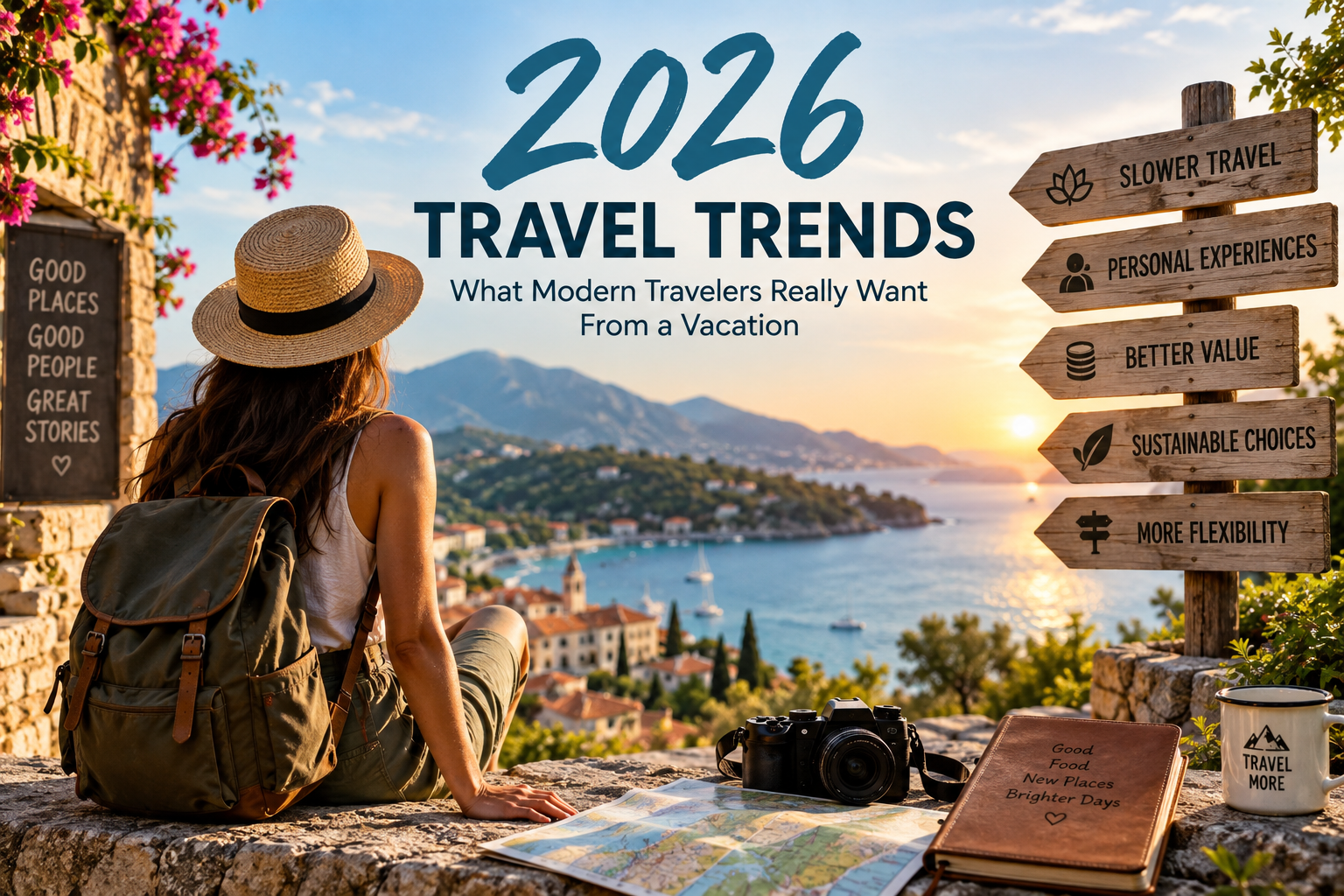

Ask someone what they want from their next holiday and you will probably get a different answer every time.
One person wants to sit by the sea for a week and do absolutely nothing. Another has a list of restaurants they want to try. Someone else wants to take the family somewhere the children will actually enjoy. And there are always those travelers who would rather rent a car, pick a direction and see where the road takes them.
That is what makes the 2026 travel trends interesting. There isn't one big holiday style taking over. Instead, people are becoming more particular about how they spend their limited time away from work and everyday responsibilities.
The destination still matters, but so does everything around it: how busy the trip feels, how much it costs, how easy it is to change plans, and whether the experience feels like something they genuinely wanted to do.
The Rush to See Everything Is Wearing Thin
Travel used to come with a strange pressure to make every minute count.
If you were visiting Rome, for example, you were expected to see the Colosseum, Vatican City, Trevi Fountain, Spanish Steps and as much else as possible before leaving. There is nothing wrong with sightseeing, but trying to fit everything into two or three days can turn a holiday into a race.
This is one reason slower trips are getting more attention.
Rather than changing hotels every night, some travelers are staying in one place for longer. They can have a late breakfast, walk around a neighborhood, stop somewhere for coffee and decide what to do next.
There is no great achievement in returning from a holiday with 200 photographs and a list of places you barely remember.
People Are Choosing Holidays That Actually Suit Them
The old idea of a “must-see” holiday doesn't work for everyone.
A food lover may be happier spending an afternoon in a local market than standing in another museum queue. A couple may want a quiet coastal town instead of a busy resort. Parents might be willing to skip a famous attraction if it means having a hotel where the children can sleep comfortably.
This is where personalization comes into the 2026 travel trends conversation.
Travelers are becoming better at deciding what they don't want. That may sound like a small change, but it can completely alter the way a trip is planned.
Instead of asking, “What are tourists supposed to do here?” people are increasingly asking, “What would I enjoy doing here?”
That usually leads to a better holiday.
Wellness Can Mean Nothing More Than a Good Night's Sleep
The word “wellness” has become a regular part of the travel industry, although it can sometimes make a simple idea sound much more complicated than it really is.
You don't need a private spa or an expensive retreat to feel better after a holiday.
Maybe you just need a quiet hotel, decent food and somewhere you can walk in the morning. Maybe you want to spend a few days near the beach without checking emails. Or perhaps the best thing about the trip is finally getting eight hours of sleep.
For people with demanding jobs and busy routines, that kind of break can be surprisingly valuable.
This more realistic view of wellness is likely to remain one of the practical 2026 travel trends. Travelers are not necessarily looking for another activity to add to their itinerary. Sometimes they are looking for fewer things to do.
AI Is Useful, But It Can't Plan the Whole Experience
Travel planning has become much easier with AI.
You can ask an AI tool to suggest destinations, compare travel options, build a rough itinerary or find activities that fit a particular budget. For someone starting from scratch, that can save hours of searching.
But there is a reason travel blogs, local guides and recommendations from friends are still useful.
An algorithm might tell you which restaurant has the highest rating. A local might tell you which one is actually worth visiting on a Tuesday evening.
That difference matters. AI will certainly play a bigger role in the 2026 travel trends, particularly during the planning stage. But once people arrive, they still want experiences that feel real. Getting slightly lost, discovering a small restaurant or changing your plans because someone recommended an interesting place is part of the fun.
The Next Great Destination May Be Somewhere Smaller
There is nothing wrong with visiting a famous city. In fact, some places are famous for very good reasons.
But travelers who have dealt with peak-season crowds know that popularity has a downside.
A growing number of people are looking at smaller towns, rural areas and less obvious destinations. They may not have a dozen world-famous attractions, but they can offer something a busy tourist center cannot always provide: space.
- You can sit in a local café without rushing.
- You may find restaurants where the menu isn't written for tourists.
- You can walk around without constantly checking a map.
For some travelers, that feels much closer to discovering a place than following a standard sightseeing route.
Cheap Doesn't Always Mean Good Value
Travelers are watching their spending, but that doesn't necessarily mean everyone is searching for the absolute cheapest option.
Imagine finding a hotel that saves you $20 a night but adds an hour of travel to every day of your holiday. The room may be cheaper, but the trip could end up costing more in transport—and you have lost several hours along the way.
The same applies to flights, tours and other bookings.
- A direct flight may cost more.
- A hotel in a better location may cost more.
- A private transfer may occasionally make sense.
One of the useful 2026 travel trends is this growing focus on value rather than simply price. People are asking what they are actually getting for their money.
A Little Flexibility Goes a Long Way
Anyone who has traveled knows that plans have a habit of changing.
A flight can be late. Rain can ruin a sightseeing day. The restaurant you wanted may be fully booked. Or you might simply wake up and decide that spending the morning beside the pool sounds better than following the itinerary.
That is why flexibility is becoming more important.
Travelers are paying attention to cancellation terms and change policies, but flexibility also means leaving some space in the schedule.
Planning every hour may look efficient when you are sitting at home. Once you're on holiday, it can become tiring.
Leave a morning open. See what happens.
Sustainable Travel Is Becoming Less Complicated
Sustainability is another part of the 2026 travel trends, although it doesn't have to involve making dramatic changes to the way you travel.
For many people, it comes down to fairly ordinary decisions.
- Stay an extra couple of days instead of constantly moving around.
- Eat at locally owned restaurants.
- Buy from small businesses.
- Avoid unnecessary waste.
- Use public transport when it is convenient.
- Treat local places and communities with some respect.
None of this requires a perfect travel record.
The point is simply to make choices that make sense for both the traveler and the destination.
What Are Travelers Really Looking For?
After looking at where travel is heading, the answer is probably less complicated than it first appears.
People want a holiday that doesn't feel like work.
They want a comfortable bed. They want good food. They want to see something interesting. They want photographs worth keeping. They want to spend time with family or friends, or perhaps have some time entirely to themselves.
Most of all, they want to feel that the money and time they spent were worthwhile.
That may explain why so many of the 2026 travel trends revolve around comfort, flexibility and personal choice rather than simply adding more destinations to the itinerary.
Final Thoughts
The travel industry will continue to introduce new hotels, new destinations, new technology and new ways to book a trip. Travelers will continue to chase famous sights too.
But the way people use their holidays is becoming more personal.
For one traveler, the perfect trip might be a week in a quiet coastal town. For another, it could be a packed city break with friends. Someone else may choose a road trip with no fixed route.
There is no right answer.
Perhaps that is the most useful thing to take from the 2026 travel trends. A good vacation doesn't need to impress anyone else. It needs to work for the person taking it.
If that means seeing five countries in ten days, go for it. If it means sitting on the same beach for five days with a book, that's fine too.
After all, you are taking a holiday to enjoy yourself—not to win a competition for who can visit the most places.