
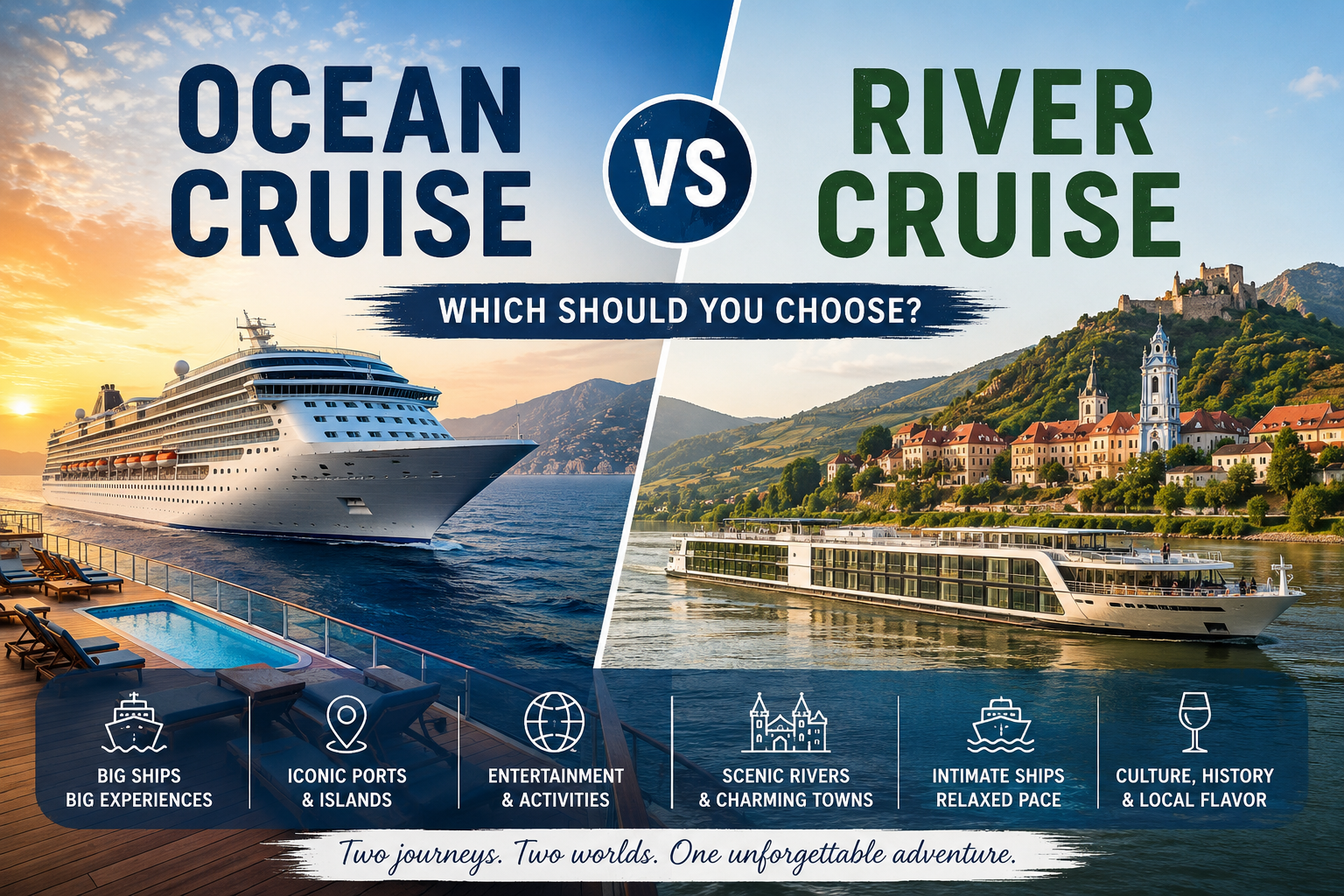

If you've
started planning a cruise, you've probably already hit the fork in the road:
ocean or river? They both promise the same basic idea — unpack once, wake up
somewhere new — but the experience underneath that promise is pretty different.
Pick the wrong one for your travel style and you might spend a week wishing
you'd booked the other.
Let's
break down what actually separates them, so you can figure out which one fits
the trip you're imagining.
The Ships Themselves
Ocean
ships are massive. We're talking water parks, ice rinks, Broadway-style
theaters, a dozen restaurants, and a few thousand fellow passengers. There's a
reason people call them "floating cities" — because that's basically
what they are.
River
ships are the opposite. They're long and narrow, built to fit under low bridges
and through tight locks, usually carrying somewhere between 100 and 200 guests.
There's no rock climbing wall, but there's also no waiting in line for the
buffet.
If you like
big energy, entertainment, and options at every turn, ocean wins. If you'd
rather sip wine on a quiet deck while watching a castle drift by, river takes
it.
Destinations and Itineraries
Ocean
cruises tend to hit major ports — think Caribbean islands, Mediterranean
coastal cities, or Alaskan glaciers. You'll typically dock for a day, explore,
then head back to a ship full of activities.
River
cruises are built for a completely different kind of sightseeing. They travel
through the heart of Europe, Southeast Asia, or Egypt, docking right in the
center of small towns you'd never reach by ocean liner. Because the ship glides
right through the destination, you get a slower, closer look at daily life
along the water.
Honestly,
this is where the biggest difference shows up. Ocean cruises are about the ship
experience plus port stops. River cruises are about the destination itself,
with the ship as a comfortable, moving hotel room.
Pace of Travel
Ocean
itineraries move fast — a new port almost every day, sometimes two in one trip.
It's exciting, but it can also feel rushed if you're someone who likes to
actually settle into a place.
River
cruises move at a walking pace, literally. You might spend an afternoon
strolling through a vineyard town, then be back on board by dinner, gliding
gently to the next stop overnight. It's a much calmer rhythm, which some
travelers love and others find a little slow.
Onboard Experience
Price and What's Included
Ocean
cruises are usually cheaper upfront, but costs add up once you factor in drink
packages, specialty dining, shore excursions, and gratuities. The base fare
gets you in the door, but the extras can surprise you.
River
cruises tend to cost more per day, but they usually include far more in that
price — meals, wine with dinner, guided excursions, even Wi-Fi in many cases.
Once you compare what's actually included, the price gap often shrinks or
disappears entirely.
Who Each One Is Really For
Ocean
cruises make sense if you're traveling with kids, want nonstop entertainment,
or you're new to cruising and want a bit of everything in one trip. They're
social, energetic, and forgiving if you don't have your whole itinerary planned
out.
River
cruises make more sense if you're drawn to history, food, wine, and smaller
towns rather than headline destinations. They also tend to attract an older,
quieter crowd, which is worth knowing if you're hoping to make friends your own
age at the pool bar — because there usually isn't one.
So, Which Should You Choose?
There's
no universal right answer here — it really comes down to what kind of trip
you're picturing. If you want big, bold, and busy, book the ocean cruise. If
you want intimate, scenic, and unhurried, the river cruise is calling your
name.
Either
way, the fact that you're even weighing the two means you're already thinking
like a smart traveler. Just picture yourself on day three of the trip — deck
chair or castle view — and you'll probably already know the answer.